



























 Defense
 Vigilance
 Seer
Seer



 How to Craft
 Choose a Crew Skill
 Armormech
 Armstech
 Artifice
 Biochem
 Cybertech
 Synthweaving
 How to Craft Fast
 Gathering Guide
 Rare Materials Guide
 White Materials Guide
 Jawa Junk
 Augments
 Medpacs, Stims and Adrenals
 Synthweaving Crafting Tree




 Crafted Decorations
 Crafted Mounts
 Crafted Dyes
 Crafted Crystals
 Events Calendar
 Galactic Seasons
 PvP Seasons
 Bounty Event
 Double XP Event
 Feast of Prosperity
 Gree Event
 Life Day
 Nightlife Event
 Pirate Incursion Event
 Rakghoul Event
 Spring Abundance Festival
 Swoop Event
 Accessibility HubAll Accessibility guides and info
 DeafPlaying while deaf or hearing-impaired
 BlindPlaying while visually impaired or with low vision
 ColorblindPlaying with colorblindness and settings options
 AnxietyPlaying with general anxiety or social anxiety

 Jedi Knight
 Jedi Consular
 Trooper
 Smuggler
 Sith Warrior
 Sith Inquisitor
 Bounty Hunter
 Imperial Agent
 Bounty Hunter
 Imperial Agent
 Jedi
Jedi Jedi Consular
 Jedi Knight
 Sith
Sith Sith Inquisitor
 Sith Warrior
 Smuggler
 Trooper
 Legacy Gear
 Lightsabers
 Double-Bladed Lightsabers
 Vibroswords
 Double-Bladed Vibroswords
 Blaster Pistols
 Blaster Rifles
 Sniper Rifles
 Blaster Cannons
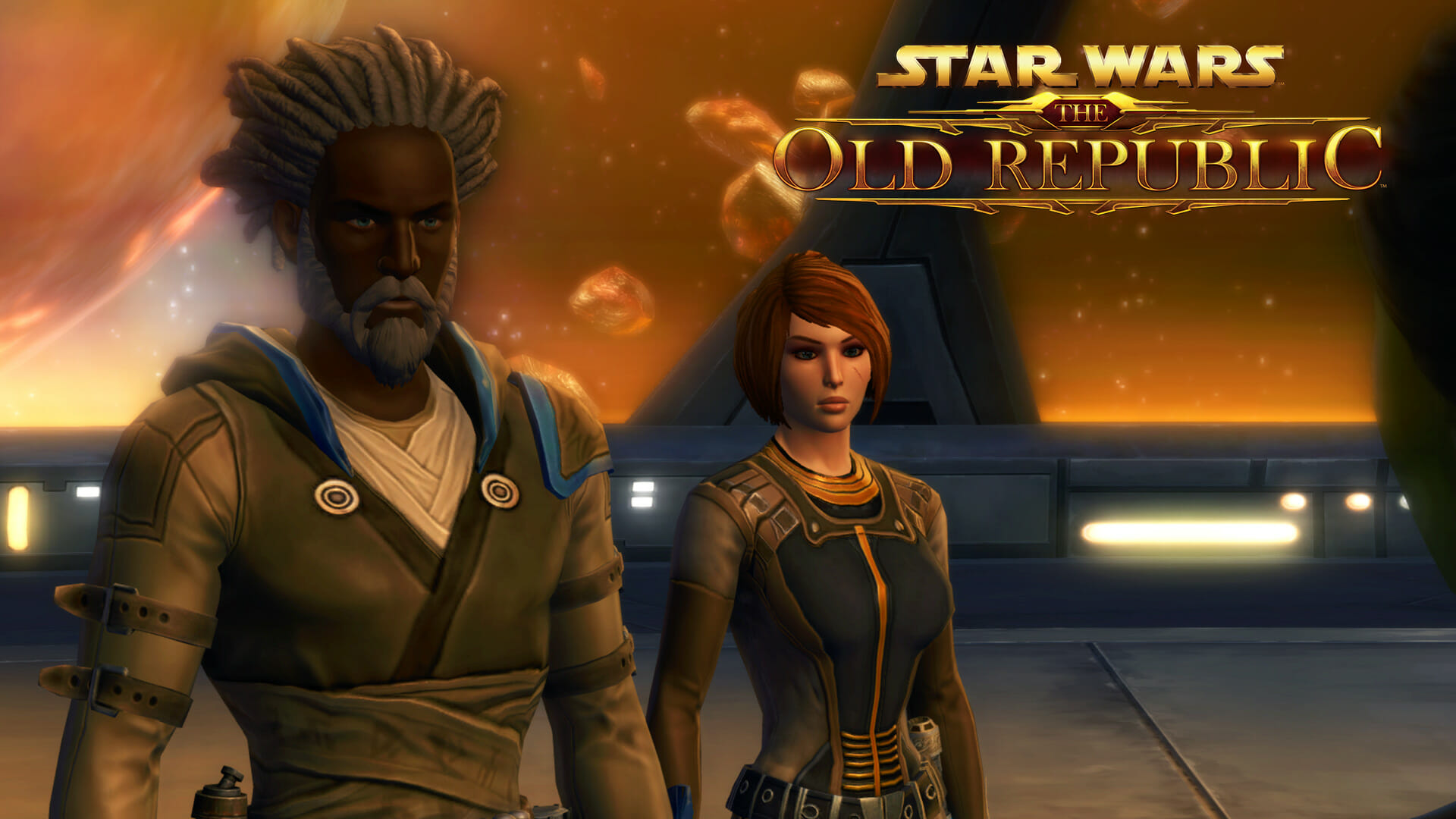

Companions follow you through your personal story in the Old Republic – they accompany you in battle, and they help you with crafting and gathering in the game.
You’ll gain companions as you play your personal class storyline, and your first companion will show up on the planet that you start your character on, near the end of your class storyline on that planet. To get your first companion, simply follow the purple quests. You might be anywhere from level 3 all the way to level 10 or higher by the time you meet your first companion.
Each class has five unique companions that you earn by playing your class quest, and you can speak to your companions as you progress through your story on your ship or in rest areas. In the past, you used to need to give your companions gifts so you could unlock more of their story, but now their stories are simply tied to your class quest progression, and as you finish your purple quests, new companion quests will usually show up when you head back to your ship. During the original stories, bringing along your class companions might trigger special dialogue during cutscenes or while wandering around the open world.
You can view all your companions by pressing the N key on your keyboard, or by going to the Companions and Contacts section of the menu. If your companion is not with you, you can press the summon button beside their name in the Companions window. To dismiss a companion temporarily, right click on their companion portrait and choose dismiss.
While in combat, most of the time you can set your companion to the role you want them to have and then focus only on your own abilities, letting your companion choose what they want to do during the fight by themselves. However, you can also manually control your companion a bit. The first option you have is whether you want them to use all their abilities or not – for example, some companions will have a stun ability, which is often useless during a difficult boss fight and would be a waste of their time. Not all companion skills are toggleable, but the ones that are have a small checkbox on them that can be right clicked to turn on and off. Second, you can, if you want, manually choose which ability you want them to do next by clicking it. Lastly, you can set your companion to Passive mode by clicking the icon of a person in a blue shirt crossing their arms. While in passive mode, companions will follow you, but they will not attack your enemies or heal you. If you’re ever finding your companion just staring at you in battle, try clicking the Passive button to turn Passive mode off. Passive mode can also be really useful during combat – if you’re trying to escape, you can toggle passive mode to run away more easily. Passive mode also allows you to position your companion a little bit – if they’re standing in something hurting them on the ground, they are not smart enough to step out of it, so if you press their passive button, they’ll run over to you, and then you can click their passive button again to have them continue healing or attacking.
Every companion has an influence level, and you can see their influence level on the Companions and Contacts window. A companion’s influence level represents how good they are in battle, and how useful they are in crafting and gathering.
If you have a companion with high influence, you might be able to solo fights that were designed for a group, like heroic missions. You can take on some really tough enemies if you have a high influenced companion with you in battle. In the past, each companion was only good for a certain role, but these days all companions can help you in all roles. To change a companion’s role, right click on their companion portrait on the bottom left of your screen and choose Healer, Tank or DPS. Most players choose to have their companion set to Healer as it’s often the easiest way to stay alive, but if you are not dying in battle, it can be faster to defeat enemies by setting your companion to DPS.
In the past, companion gear would affect their combat abilities – but now it’s just cosmetic, and Influence is what determines how strong they are in battle.
Influence also increases their success at crew skills. It makes them craft and gather faster, as well as makes them more likely to get rare materials when they go gathering, or have a higher chance to craft an extra item or an augmented item when crafting.
At influence level 50, a companion will have the following benefits: 25% critical bonus for crew skills, a 75% time bonus for crew skills where a 1 hour mission would only take 15 minutes, and a 2500 Presence bonus, which makes them quite strong in combat.
You can gain influence a few different ways. The first is by taking them along while questing, and choosing options they agree with during cutscenes. The second is by giving them gifts. Some gifts are worth far more influence than others, depending on their gift rank, their rarity, and how much your companion likes that type of gift. Gifts can be gotten from a variety of ways, including crew skills, various vendors, and the GTN. To learn more about giving gifts to your companion, visit swtorista.com/gifts for a full guide about which companions like which gifts, and where to get all the different types of gifts in the game.
There’s also a third option to get your companion up to 50 quickly. Using a Companion Compendium is the fastest way to get to Influence 50 and levels your companion to influence level 50 immediately, without using gifts. You can either get one in the Strongholds section of the Fleet for 3 Dark Projects plus 4.25 million credits from a droid named V1C-0RY, or buy them from the Cartel Market or with credits on the GTN.
Another statistic that affects your companion’s combat skill is Presence, which is earned by your character. You can earn Presence by unlocking the human species by leveling to 50 on a human character or buying the unlock, a +10 permanent legacy presence bonus for each companion you finish companion conversations with, from Datacrons, amplifiers and a few other ways. Unlike many other stats in the game, Presence has no real limit, so it can be fun to beef up your presence on your gear for low-level content.
While you have a companion out, you have the chance to use three special abilities during combat if you’ve earned them.
- Heroic Moment, which heals you and your companion and allows you to use any heroic abilities you’ve earned through the class stories
- Unity, is an ability that heals you and your companion, and you can earn it for your entire legacy by reaching light 5 on one of your characters
- And Sacrifice, which heals you 40% of your health, but nearly kills your companion in return, is pretty much never used unless your companion is almost already dead
Once you reach the Knights of the Fallen Empire expansion, the third expansion, the number of companions you can have drastically increases, and there’s a ton of different companions you might wind up with. Some you will earn through the main story naturally, while others require that you complete a special type of quest called an Alliance Alert. You can start Alliance Alerts after Chapter 9 of Knights of the Fallen Empire, and your Alerts can be seen in the Companions and Contacts window. Some Alerts are only for certain classes, and some alerts require that you finish certain parts of the story before showing up, or require that you finish other alerts first. You can even earn some companions from other classes. To learn more about companion recruitment and how to get all the companions, visit swtorista.com/recruitment
Heads up once you start Knights of the Fallen Empire, some funny stuff can happen with the availability of your companions. If this is your first play-through of the expansions, just keep playing and eventually you’ll get your companions back, either through the chapters or through the alerts. This is simply how the Knights expansions work. If you’ve already earned your companions back, and this is a re-play, for example you started a chapter through the chapters window, you may need to finish your active chapter before you can access them again. This is somewhat of a bug – sometimes the companions are disappearing because they would be missing during that chapter, other times they just become unavailable for no reason. The fastest thing to do if this happens is to switch to Chapter 9 of Knights of the Fallen Empire and spacebar through it, as there’s no combat in this chapter and it’s the quickest one to complete. This missing companion bug can also sometimes occur if you have an Alert quest open – you can drop it or complete it to bring that companion back.
On top of the companions you earn the through the story and quests, there’s also an assortment of companions you can get from the Cartel Market, either with Cartel Coins or bought with credits from other players on the GTN. These Cartel Market droids and beasts are more for long-time players who are looking for more variety, and do not offer and special boosts in battle. In fact, they’re technically considered worse than companions you earn, as they do not have the ability to craft or gather, and don’t have any dialogue at all.
Lastly, there are a few very special companions that can only be earned very specific ways. These include:
- Darth Hexid, who can only be earned through group activities, and I’ve got another video guide about her called “How to Earn Darth Hexid”
- HK-51, who requires a long quest chain started in Section X
- Treek, who can either be bought on the Cartel Market or through the Legacy system
- The Gamorrean Guard companion and Phrojo Nuray rodian companion that only come from the once-yearly Nar Shaddaa Nightlife event
- Quick Vrik the Uggnaught companions from the Dantooine Pirate Incursion re-occuring event
- H2-WF, an uncommon droid companion dropped from the A Traitor Among the Chiss Flashpoint
- And Lysslo, a very small, very rare Geonosian bug companion from the Hive of the Mountain Queen single-boss Operation Ossus
In general, while all companions are roughly equal, Shae Vizla is considered the strongest damage companion followed by any dual-wielding lightsaber companions including the now-retired Master Ranos, Ashara or Veeroa Denz, then by dual-wielding blaster pistol companions like Theron, Vette. For healing, use Z0-0M if you have her, followed by dual-wielding blaster wielders and then by dual-wielding lightsaber wielders.
Companions are one of the more unique options available in Star Wars: The Old Republic compared to other online games, and discovering their stories through their missions or bringing them along for difficult fights can be very satisfying. With over 93 companions, you should be able to find your perfect combat buddy or story partner. If you want to learn more about gifting for each companions, I’ll have another video called “SWTOR Companion Gifts” and if you want to learn more about building your alliance, I’ll have another video up called “How to Recruit SWTOR Companions”.
 Questions or comments? Feel free to send me a message on Twitter








 Discord
  Email swtorista@gmail.com
 Bluesky @swtorista.com
 Reddit /u/swtorista
 Twitch Swtorista
 Youtube
 Patreon
 Twitter @swtorista